

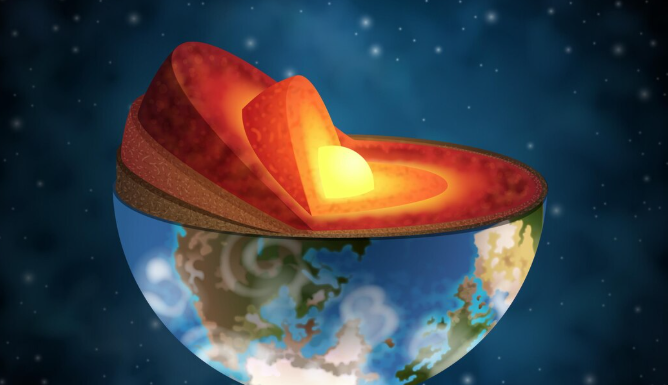
The air seems unaffected by human concerns when you are in a remote location, such as a desert plateau or a ridge above the treeline. However, liquid iron is churning in slow, violent loops somewhere 1,800 miles below your feet, creating a force field that has silently sustained life on Earth for billions of years. Earth’s magnetic shield is that field. And throughout geological history, it has flipped its polarity hundreds of times without any prior notice or announcement.
The poles are not stationary. They weren’t. Technically speaking, what we refer to as magnetic north is actually a magnetic south pole; the geographic North Pole is magnetically southern, which is why the north-seeking needle of a compass is drawn to it. It sounds like a peculiarity of physics, and it is. The deeper oddity, however, is that, going back as far as records go, the entire arrangement has completely and repeatedly reversed itself. Over the past 170 million years, scientists have counted about 540 of these flips. Some endured for several millennia. According to a recently released study, one reversal occurred 40 million years ago and lasted for roughly 70,000 years.
| Parameter | Detail |
|---|---|
| Phenomenon | Geomagnetic Reversal (Polarity Flip) |
| Field Source | Liquid nickel-iron outer core, ~1,800 miles below the surface |
| Average Reversal Frequency | Every 300,000 years (irregular — no fixed cycle) |
| Last Full Reversal | ~780,000 years ago (Brunhes–Matuyama reversal) |
| Known Reversals (record) | ~540 polarity flips over the last 170 million years |
| Typical Duration of a Flip | Thousands of years (some as long as 70,000 years) |
| Current Field Strength Change | ~10% decrease since the 1830s — within normal variability |
| Notable Near-Reversal Event | Laschamps Excursion (~42,000 years ago) — linked to climate disruption |
| Longest Stable Period on Record | Cretaceous Normal Superchron — over 40 million years without a flip |
| Key Risk During Reversal | Weakened magnetic shield — increased solar radiation exposure |
| Mass Extinction Correlation | No confirmed direct link to mass extinction events |
It’s not a quick change. That’s more time than modern humans have spent creating art, interring their dead, or engaging in many other aspects of civilization. The planet is partially exposed to solar radiation that our field normally deflects due to 70,000 years of magnetic instability and a weakened shield. We may not yet fully understand the effects of such a protracted reversal. The sediment cores they examined, which were taken from the deep seafloor, present a more nuanced picture than the traditional textbook depiction of a swift, clean polarity swap, the researchers who published these findings in Nature Communications Earth & Environment were careful to point out.
The outer core, a 2,250-kilometer shell of electrically conducting liquid iron and nickel that is heated from below and cooled from above and rotates and convects in patterns influenced by Earth’s rotation, is the generator behind it all. The flows have a helical structure due to the Coriolis effect. Through electromagnetic induction, those helical flows produce and maintain the magnetic field. It is a self-sustaining dynamo with the potential for abrupt regime changes, just like any complex nonlinear system. Not necessarily caused by anything outside of oneself. Just a tipping point in internal dynamics.
If you sit with it long enough, the unpredictable nature becomes unsettling. Reversals do not occur on a regular basis. They don’t adhere to a schedule. The Earth’s field didn’t flip for more than 40 million years during the Cretaceous, a time of enormous dinosaurs and wide shallow seas. Other periods, however, crammed several reversals into a comparatively brief period of time. According to a 2019 National Geographic article, the poles may have been swapping much more quickly than they do now, some 500 million years ago. In essence, the field does what it wants, and our role has been to watch and document after the fact.
Measurements made since the 1830s, when trustworthy magnetometers first became available, are the source of the current concern, which is a concern rather than a crisis, at least not yet. The average strength of the Earth’s magnetic field at the surface has decreased by about 10% during that time. That sounds concerning. It isn’t, not by default. On this point, the USGS has been quietly consistent: a decrease in field intensity does not indicate an impending reversal. The field is not constant. It has previously experienced dips and recoveries without ever completing a full polarity switch. “For all we know,” the agency says, shrugging like a geologist, “the field may actually get stronger at some point in the not-so-distant future.”
However, the weakening is real and has implications that go beyond the calibration of the compass. The magnetic shield deteriorates during a reversal or even during a partial or transient deviation known as a geomagnetic excursion. Normally deflected cosmic rays, solar wind, and coronal mass ejections begin to reach deeper into the atmosphere. Earth’s field collapsed to a fraction of its typical strength for centuries approximately 42,000 years ago due to a geomagnetic excursion known as the Laschamps Event. Researchers at the University of Utah discovered evidence that connected that event to significant changes in the climate, the extinction of megafauna in Australia, and alterations in early human behavior. Correlation, not causation, but it’s hard to completely rule out the timing.
Reading these studies gives the impression that the field reversal narrative is one that science has been subtly updating for decades, with each new data set pushing the picture closer to complexity. The 70,000-year reversal duration is noteworthy in part because it indicates that “a reversal” is an era rather than a single event with a start and finish date. An era where satellites and electrical grids are under increased radiation stress, where aurora displays may occur at equatorial latitudes, and where the compass is unreliable. When you think about the implications for infrastructure, the idea of the northern lights illuminating the entire planet seems almost romantic.
It is still practically impossible to predict when the next one will begin. According to scientists, we wouldn’t be able to verify that a reversal was happening until it was halfway through. The idea that one of the most important geophysical events could start and the most advanced civilization in human history might not recognize it for what it was until it was already halfway through has stuck with me. The planet occasionally reminds us that geological time does not cooperate with human schedules, which is a peculiar kind of humility.
As of right now, the poles are still drifting; magnetic north has been moving toward Siberia for years at a discernible rate. The field wanders and pulses. No instrument has ever seen the patterns in which iron flows beneath us. No one can honestly predict whether a reversal will occur in centuries or millions of years. It appears obvious that life has endured through all of the planet’s previous, numerous instances of this. You shouldn’t stop paying attention because of that. It might be the most compelling reason to begin.
