

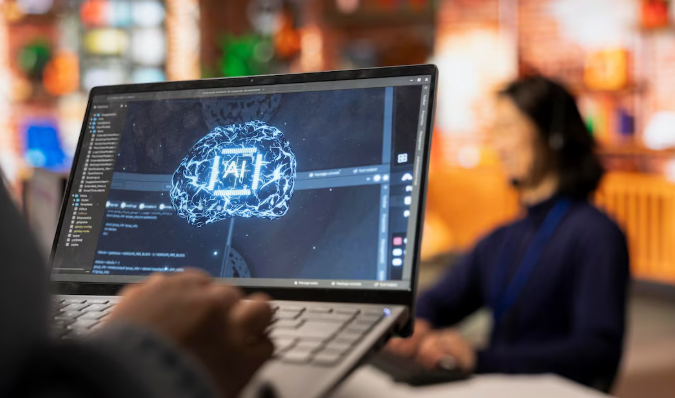
It was challenging to watch a video that surfaced online in March 2024 without pausing to reflect. A 29-year-old man who had been paralyzed from the shoulders down due to a diving accident eight years prior sat in front of a screen and used only his thoughts to move a cursor across it. He said the gadget inside his skull was simple to operate. He claimed to have been playing chess. He had been sharing content on social media. Like someone discussing a new laptop that occasionally runs slowly, he said, almost casually, that things weren’t perfect yet. His name is Noland Arbaugh, and he was the first person to receive a Neuralink brain implant in January 2024.
Formally known as the N1 implant and internally called “Telepathy,” the device records electrical signals from the motor cortex of the brain, which controls movement intention. With an accuracy that no human hand could match, a surgical robot known as R1 inserts incredibly thin, flexible threads into that area. Once inserted, the implant is aesthetically undetectable and sits flush beneath the skull.
| Category | Details |
|---|---|
| Company | Neuralink — founded by Elon Musk |
| Device Name | N1 Implant (“The Link”) / Telepathy |
| Trial Name | PRIME Study (Precise Robotically Implanted Brain-Computer Interface) |
| FDA Approval for Trials | May 2023 (Investigational Device Exemption) |
| First Human Implant | January 29, 2024 |
| First Patient | Noland Arbaugh, 29 years old — quadriplegic since a 2016 diving accident |
| Implantation Method | R1 Robot surgically inserts ultra-fine flexible threads into motor cortex |
| Device Function | Records neural signals wirelessly; decodes movement intention via app |
| Early Challenge | Several threads retracted post-implant; algorithm adjusted to compensate |
| Second Patient | “Alex” — spinal cord injury; implanted August 2024 |
| Total Trial Hours (by Feb 2025) | Over 4,900 hours of device use across three participants |
| CONVOY Study | Launched November 2024 — testing control of assistive robotic arms |
| Blindsight Implant | FDA “Breakthrough Device” status granted September 2024 — targets vision restoration |
| Eligible Conditions | Quadriplegia (cervical spinal cord injury) or ALS |
| Long-Term Goal | Restore autonomy; future expansion to vision, communication, and smartphone control |
It wirelessly transmits neural data to an external application that interprets brain activity and converts it into digital action. The original objective was simple: enable paralyzed individuals to operate a computer keyboard or cursor solely by thought. That objective was being reached and surpassed within weeks of Arbaugh’s implant. In terms of cursor control speed, he set a world record. The figures exceeded Neuralink’s publicly stated projections.
Then, shortly after that initial success, something went awry. The tiny filaments that connect the implant to neural tissue, known as threads, retracted from Arbaugh’s brain in several places. Performance declined. It was the kind of setback that could have ended a trial or at the very least raised grave concerns in a different situation. Instead of waiting for a hardware solution, Neuralink changed the decoding algorithm to make it more sensitive to the residual neural signals. It was successful. According to later reports, control speed was reinstated and even surpassed the initial baseline. It’s still genuinely unclear if that algorithmic workaround is a long-term fix or a band-aid fix for a structural issue. However, it continued the trial.
By August 2024, a second patient with a spinal cord injury, known only as “Alex,” had received the implant and was utilizing it to operate digital gadgets. The CONVOY Study, a feasibility study that Neuralink initiated in November to see if the N1 device could go beyond screen control to operate assistive robotic arms, a significant step toward physical autonomy rather than just digital access. Three people had been enrolled in trials by February 2025, and between them, they had used the device for more than 4,900 hours. It’s important to keep both of those things in mind at the same time because that’s a lot of data from a very small sample. The outcomes are remarkable. The population is still very small.
Every announcement in the Neuralink story over the past year has a hint of tension beneath the surface. Elon Musk, the company’s leader, is known for framing his endeavors in maximalist terms. For example, he refers to the implant as “Telepathy,” discussing the long-term objective of seamless smartphone control as an engineering problem with a clear timeline rather than a frontier with unknown terrain ahead. Excitement, investment, and media attention are generated by this framing. Additionally, it fosters a level of skepticism that more cautious businesses do not encounter.
Concerns regarding informed consent, the long-term effects of having electrodes embedded in brain tissue, what happens to the neural data being transmitted wirelessly, and who ultimately controls it have been raised by researchers and ethicists who have examined the PRIME Study data. The scientific community criticized Neuralink’s early lack of transparency regarding trial registration, according to a paper published in Frontiers in Human Neuroscience in early 2025. This serves as a reminder that the ethical framework surrounding this technology is still being put together while the technology itself advances.
It’s possible that none of the worst worries come to pass. It’s equally possible that some of them do, in ways that take years to become apparent. Neuralink is not operating in a vacuum because brain-computer interface research has been ongoing since at least 1998, when the first invasive BCI was implanted in a human patient. However, it is operating at a scale, speed, and public visibility that previous researchers never attempted. Neuralink’s Blindsight implant, which aims to restore vision through direct cortical stimulation, was granted “Breakthrough Device” status by the FDA in September 2024. This indicates that regulators are taking the technology seriously rather than keeping it at a distance. That is noteworthy. It indicates that the discussion is no longer theoretical.
The philosophical discussions taking place in regulatory offices and university workshops, in Noland Arbaugh’s opinion, are somewhat irrelevant. He needed ongoing help prior to the implant. For the first time in years, he was able to use a cursor, play video games, browse the internet, and communicate on his own terms. Documented over thousands of hours of device use, that is a genuine and distinct change in one person’s life. That portion of the story doesn’t require qualification, regardless of the numerous complex issues surrounding the technology.
