

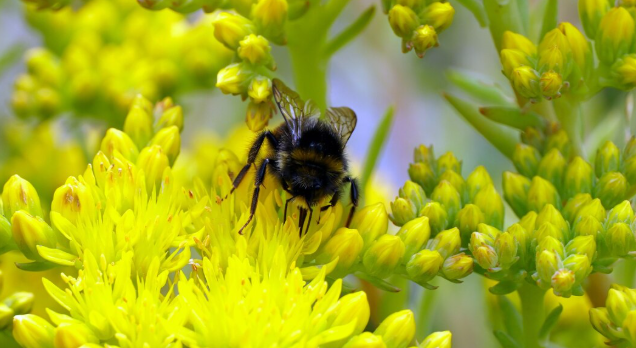
It all began with an error. While pursuing her doctorate at the University of Guelph in Ontario in 2022, Sabrina Rondeau conducted research on the effects of pesticides on bumblebees in the winter. Her setup was simple: to replicate the cold, dark conditions of a natural burrow, queens were placed in refrigerated tubes filled with soil. Four of those tubes eventually had water seeping into them.
The queens were completely immersed. When Rondeau came upon what must have appeared to be a botched experiment, she discovered something completely unexpected. The bees were still alive. sitting there, seemingly unfazed, underwater. One of the most unexpected areas of insect research in recent memory was quietly started by that accident.
| Field | Details |
|---|---|
| Species Studied | Bombus impatiens (Common Eastern Bumblebee) |
| Discovery Origin | Accidental lab flooding — PhD researcher Sabrina Rondeau, University of Guelph, Ontario (2022) |
| Initial Survival Study | Published in Biology Letters, 2024 — 143 queens tested; ~90% survived 1 week submerged |
| Mechanism Study | Published in Proceedings of the Royal Society B, March 2026 |
| Lead Researchers | Charles-Antoine Darveau (University of Ottawa); Sabrina Rondeau; Skyelar Rojas |
| Key Survival Mechanisms | Profound metabolic depression, underwater gas exchange (physical gill), anaerobic metabolism |
| Metabolic Rate Change | CO₂ production dropped from ~15.42 to ~2.35 µL/hr/g after 8 days submerged |
| Diapause Metabolism Reduction | Over 95% below normal active metabolism |
| Byproduct of Anaerobic Activity | Lactate (cleared over several days post-submersion) |
| Conservation Relevance | Survival mechanism against increasing spring flood events due to climate change |
| Reference Website | Royal Society Publishing – Proceedings B |
During the winter, the common eastern bumblebee, Bombus impatiens, goes into a state known as diapause, which is a form of suspended animation that is more profound and physiologically extreme than regular sleep. It is similar to what occurs when a bear hibernates but is compressed into a much smaller body. In the fall, the queen burrows into the ground, where her metabolism falls by over 95%. Until spring, her body runs on the bare minimum needed to keep cells functioning.
She is as close to suspended as a living thing can be, but she is not dead. It turns out that underground burrows flood fairly frequently due to heavy rain, snowmelt, and rising water tables, and a queen in deep diapause lacks the practical ability to just wake up and move. Therefore, the question raised by Rondeau’s accident was genuinely intriguing: how does a terrestrial insect avoid drowning when buried in flooded soil and essentially frozen in metabolic slow motion?
The official response came in March 2026 when a group at the University of Ottawa under the direction of evolutionary physiologist Charles-Antoine Darveau published their research in the Proceedings of the Royal Society B. After immersing dozens of lab queens and tracking their gas exchange and metabolic output over several days, they discovered a three-part survival system functioning concurrently.
First, even when completely submerged, the queens continued to exchange gases, taking in oxygen and releasing carbon dioxide in a manner that was consistent with real respiration. In the sealed water chambers, oxygen levels decreased while carbon dioxide levels slightly increased. The bees were breathing. Breathing, but not rapidly or effectively by any conventional measure. Second, the researchers found that submerged queens had an accumulation of lactate, a chemical byproduct of anaerobic metabolism, which is how cells produce energy when there isn’t enough oxygen present.
The queens’ cells changed modes and began functioning without oxygen when the amount they could draw from the water was insufficient to meet even their drastically lowered requirements. Third, and perhaps most astonishingly, during submersion, their metabolism decreased even more, compressing what was already a nearly undetectable low metabolic rate to about one-sixth of its diapausing baseline. Before submersion, carbon dioxide production was approximately 15.42 microliters per hour per gram of body mass; after eight days underwater, it was only 2.35. The body was only doing what it needed to survive.
It is noteworthy that there is still some mystery surrounding the actual oxygen extraction mechanism. According to Darveau’s team, the queens use what scientists refer to as a “physical gill,” which is a thin layer of trapped air that serves as an interface between the bee’s respiratory system and the surrounding water, enabling gas exchange.
Although many aquatic insects employ this tactic, it is noteworthy that Bombus impatiens, a terrestrial species rather than an aquatic one, has independently developed something functionally similar. Further in-depth research is still needed to confirm this physical gill mechanism. That gap serves as a modest but truthful reminder that there are still unexplored areas of biology in 2026.
Beyond the neat science of the story, there is something subtly captivating about it. The populations of bumblebees, which are among the most ecologically significant pollinators in North America, have been under stress for many years due to habitat loss, pesticide exposure, and the kind of erratic weather patterns that result in the precise spring flooding events that this study examines.
In light of the changing climate, it is actually significant news that at least one species seems to have evolved a biological buffer against flood events. Although it doesn’t address the more general issues that pollinator populations face, it does point to a resilience that wasn’t previously recognized or taken into consideration. In ways that scientists are just starting to map, knowing which species have these kinds of hidden tolerances and under what circumstances they hold is important for conservation planning.
The queens did not just return to normal after being taken out of the water. As their bodies processed the stored lactate and gradually restored metabolic function to its normal diapausing level, they took days to recover, breathing at higher rates.
The long, slow return from an extreme state, the body clearing out what the emergency produced and resetting itself for the upcoming season, is almost recognizable when you watch that recovery process or read the data that describes it. Presumably, the queen is unaware that she almost drowned. As scheduled, she simply awakens in the spring and begins to rebuild a colony from the ground up, bringing with her all the genetic material required for her species to survive. The flood was merely an event. It was handled by her body.
It’s difficult not to think that’s at least a little unusual. Not dramatic, not cinematic, but subtly remarkable in the manner that successful biological adaptation usually is. In order to verify the physical gill mechanism and test the limits of this survival capability under various water temperatures and submersion durations, the researchers have already planned follow-up work.
There’s a good chance that other species of bumblebees have comparable adaptations that haven’t been found yet because no one has looked for them. The problem with unintentional discoveries is that they provide answers to multiple questions. They open a door to a corridor that is longer than anticipated and full of questions that no one had considered asking.
